
The pursuit problem
The pursuit had to make integrated community-equipment provision and support credible against close buyer scrutiny of correct specification, urgent availability, installation safety and repair and reuse traceability.
Case study · Public health and community services
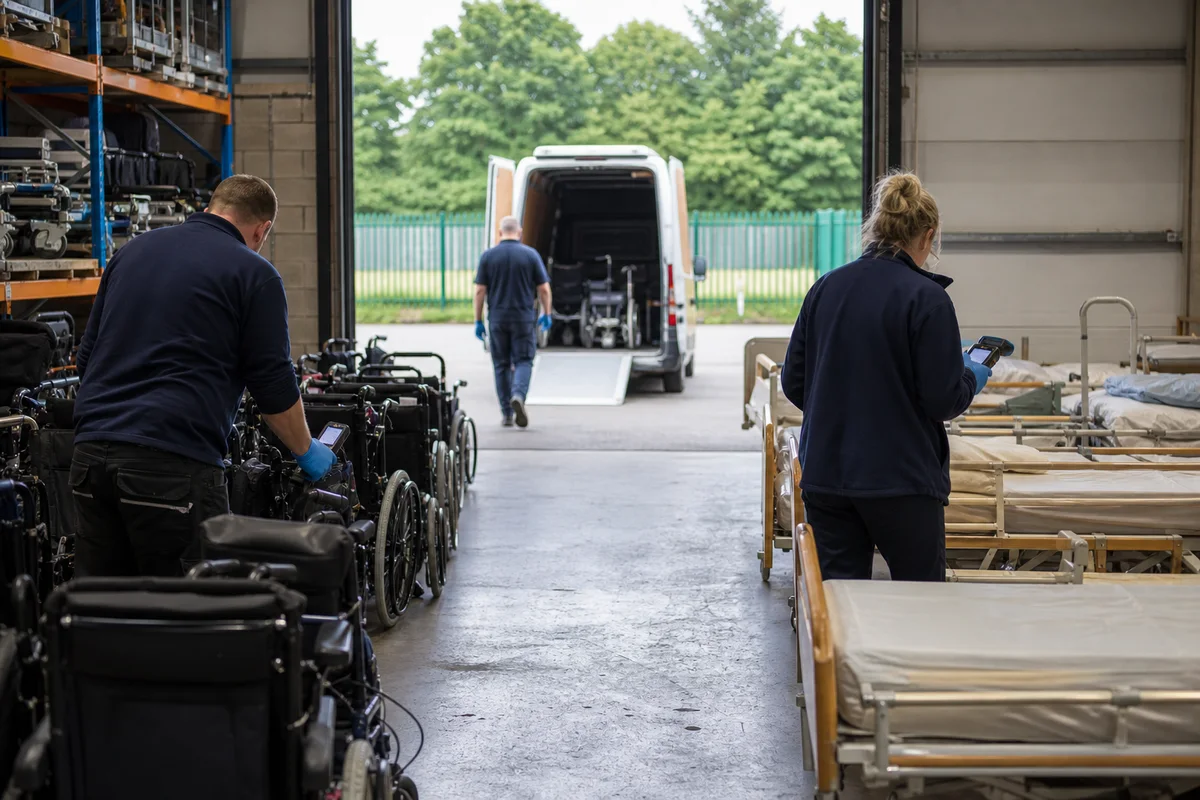
The client was selected by a local authority to provide integrated provision and support of daily-living and community equipment.
Client confidentiality Client identity and sensitive details are withheld; project facts are generalised only where needed to keep the case useful without identifying protected parties.
The pursuit had to make integrated community-equipment provision and support credible against close buyer scrutiny of correct specification, urgent availability, installation safety and repair and reuse traceability.
Bid Champions’ team supported the agreed tender workstream through to submission.
Contract award secured. Contract value: £3m+. The client retained a reusable public-sector reference for community equipment, responsive logistics and lifecycle control.
Work carried out by Bid Champions
The pursuit moved through five connected stages, with each decision tied to a practical output and the final submission.
The response had to prove correct specification, urgent availability, installation safety and repair and reuse traceability.
Need and specification
Showed referral or ordering inputs, specification, compatibility, clinical or technical approval and substitution control.
Project output A need-to-product decision matrix with approval evidence.
Catalogue and supply chain
Set out product coverage, standards, supplier controls, stock policy, lead times, recalls and alternatives.
Project output A controlled catalogue and supply-chain resilience register.
Delivery and installation
Explained scheduling, access, safe handling, installation, demonstration, acceptance and failed-delivery management.
Project output A delivery-and-installation workflow with proof points.
Support and lifecycle
Showed maintenance, repair, collection, decontamination, reuse, disposal, helpdesk and urgent replacement routes.
Project output A lifecycle service model with response standards and records.
Governance and evidence
Defined inventory accuracy, service levels, complaints, incidents, audit, reporting and improvement ownership.
Project output A performance and assurance schedule with closed-loop actions.
The buyer can test whether the bidder controls both the product and the service surrounding it across the full equipment lifecycle.
Inside the buyer decision
Each card follows the same route: the risk, the work completed, the proof created and the effect on the decision.
Buyer decision
Operating reality
Commercial pressure
Stakeholder fit
Professional controls applied to the problem
These examples are tied to the work and outputs above, within the wider assurance approach used across the project.
These three APMP proposal-management practices shaped the requirement, evidence and release work for £3m+ public-sector award for integrated community-equipment provision and support.
Showed referral or ordering inputs, specification, compatibility, clinical or technical approval and substitution control. A need-to-product decision matrix with approval evidence.
Showed maintenance, repair, collection, decontamination, reuse, disposal, helpdesk and urgent replacement routes. A lifecycle service model with response standards and records.
Explained scheduling, access, safe handling, installation, demonstration, acceptance and failed-delivery management. A delivery-and-installation workflow with proof points.
These are three relevant examples from the broader project assurance—not the full set of controls applied.
For this £3m+ public health and community services pursuit, a key driver was requirement ownership, evidence traceability, staged review and release control. It governed A performance and assurance schedule with closed-loop actions and directly addressed correct specification, urgent availability, installation safety and repair and reuse traceability.
For this £3m+ public health and community services pursuit, a key driver was competence, hazards, safe work methods, supplier controls and incident learning. It governed A delivery-and-installation workflow with proof points and directly addressed correct specification, urgent availability, installation safety and repair and reuse traceability.
For this £3m+ public health and community services pursuit, a key driver was disruption scenarios, recovery ownership, minimum service and mobilisation readiness. It governed A controlled catalogue and supply-chain resilience register and directly addressed correct specification, urgent availability, installation safety and repair and reuse traceability.
This sequence connected the buyer’s concern to owned work, reviewable evidence and the final release decision.
How Bid Champions applies APMP and APM practiceHow standards support the pursuit
Why the bid won
The buyer can test whether the bidder controls both the product and the service surrounding it across the full equipment lifecycle.
The response built buyer confidence around broad equipment coverage, responsive logistics, installation and demonstration and lifecycle support. The winning pattern was a compliant and commercially acceptable response that converted those capabilities into a joined equipment, logistics and support service, reducing perceived execution risk.
What remained after submission
The client retained a reusable public-sector reference for community equipment, responsive logistics and lifecycle control.
Decision room · Public health and community services · 3 decisions · About 60 seconds
Solve three connected pieces of the pursuit. Choose a route, then reveal what happened on this project.
The pursuit had to make integrated community-equipment provision and support credible against close buyer scrutiny of correct specification, urgent availability, installation safety and repair and reuse traceability.
Decision 1 of 3
Decision 01
What happened on the project Translated assessed need into an approved solution. A need-to-product decision matrix with approval evidence.
Decision 02
What happened on the project Controlled the last mile. A delivery-and-installation workflow with proof points.
Decision 03
What happened on the project Connected performance to corrective action. A performance and assurance schedule with closed-loop actions.
What happened
The buyer can test whether the bidder controls both the product and the service surrounding it across the full equipment lifecycle.
Contract award secured. Contract value: £3m+. The client retained a reusable public-sector reference for community equipment, responsive logistics and lifecycle control.
Result£3m+ · Contract award secured
Facing a similar constraint?
We can test the buyer route, strengthen the bidder and offer, build the evidence and commercial case, write the response and control it through submission.