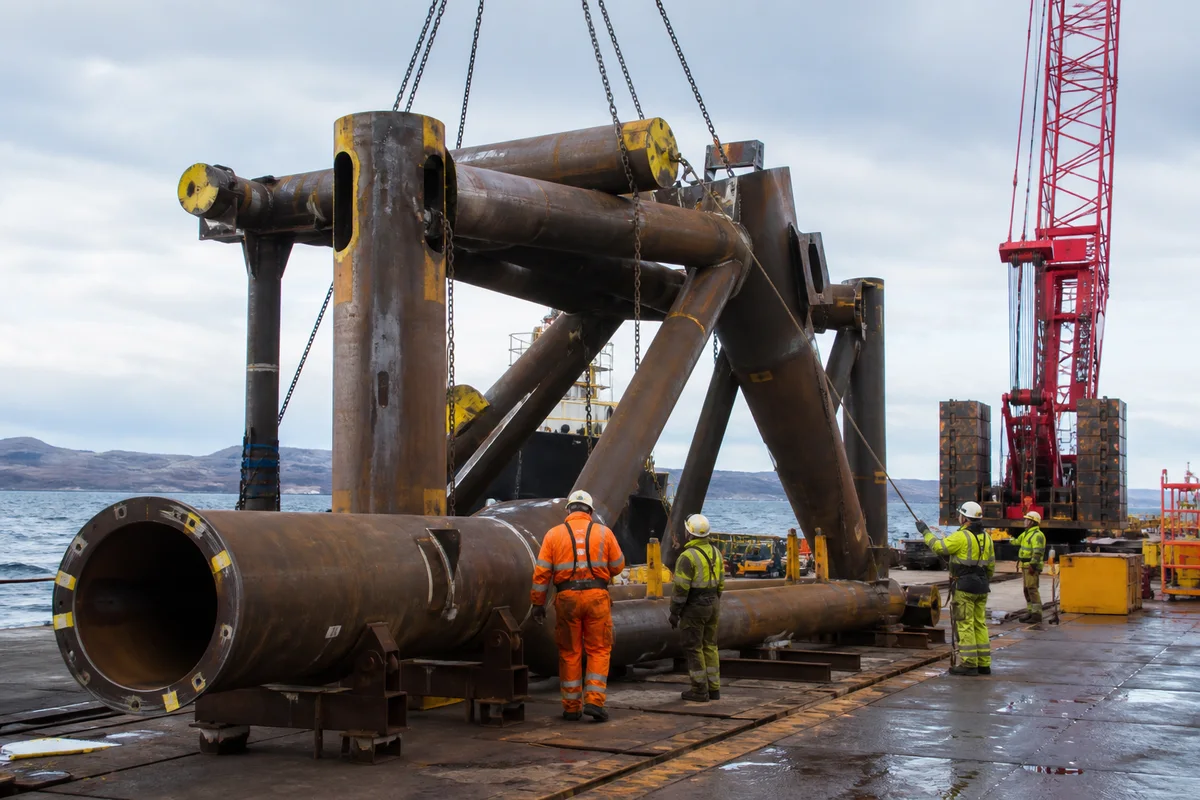
Case study · Maritime and ports

£3m+ private-sector award for subsea structure fabrication

The client was selected by offshore energy operator to deliver fabrication of mission-critical subsea structures under a master agreement. Bid Champions supported the private pursuit through to contract award.

Editorial delivery context for £3m+ private-sector award for subsea structure fabrication
Maritime and ports
Contract
Private
Buyer
offshore energy operator
Contract value
£3m+
Result
Award
Route
Technical package tender or EPC-style procurement

Client confidentiality Client identity and sensitive details are withheld; project facts are generalised only where needed to keep the case useful without identifying protected parties.

Before

The pursuit problem

The pursuit had to make subsea structure fabrication credible against close buyer scrutiny of HSE performance, specialist engineering, vessel or yard capacity, weather and marine logistics, interface management, quality and schedule certainty.

Bid Champions’ role

What changed

Bid Champions’ team supported the client’s winning private pursuit, applying the recorded engineering basis, execution method, hse and marine control, interface management and schedule challenge stages.

After

The result

Award. Contract value: £3m+. The client retained a market reference for subsea structure fabrication and the buyer-risk pattern behind it.

Work carried out by Bid Champions

The work behind this £3m+ maritime and ports pursuit.

The pursuit moved through five connected stages, with each decision tied to a practical output and the final submission.

Decision to unlock

HSE performance, specialist engineering, vessel or yard capacity, weather and marine logistics, interface management, quality and schedule certainty.

  1. 01

    Engineering basis

    Engineering basis

    Decomposed scope, specifications, interfaces and acceptance criteria.

    Project output A controlled engineering compliance map.

  2. 02

    Execution method

    Execution method

    Showed yard, vessel, fabrication, offshore sequence and resource readiness.

    Project output A buildable execution plan.

  3. 03

    HSE and marine control

    HSE and marine control

    Connected permits, hazards, weather limits and emergency arrangements.

    Project output A joined HSE and marine assurance case.

  4. 04

    Interface management

    Interface management

    Assigned owners for client, asset, supplier and offshore dependencies.

    Project output An interface and decision register.

  5. 05

    Schedule challenge

    Schedule challenge

    Stress-tested long leads, weather, defects and recovery options.

    Project output A realistic programme risk model.

Project control spineOffshore requirement → engineered method → marine and HSE control → interface plan → assured execution

Why it mattered

It turns a private buyer’s commercial and operational concerns into a controlled answer, proof and negotiation route while preserving a controlled negotiation route.

Inside the buyer decision

Four shifts in the buyer’s risk picture.

Each card follows the same route: the risk, the work completed, the proof created and the effect on the decision.

  1. 01

    Buyer decision

    Engineering basis

    01 · The risk
    The pursuit had to make subsea structure fabrication credible against close buyer scrutiny of HSE performance, specialist engineering, vessel or yard capacity, weather and marine logistics, interface.
    02 · Work completed
    Decomposed scope, specifications, interfaces and acceptance criteria.
    03 · Proof created
    A controlled engineering compliance map.
    Outcome · Decision effect
    A controlled engineering compliance map gave offshore energy operator a concrete basis for judging buyer decision.
  2. 02

    Operating reality

    Execution method

    01 · The risk
    HSE performance, specialist engineering, vessel or yard capacity, weather and marine logistics, interface management, quality and schedule certainty.
    02 · Work completed
    Showed yard, vessel, fabrication, offshore sequence and resource readiness.
    03 · Proof created
    A buildable execution plan.
    Outcome · Decision effect
    offshore energy operator could test operating reality against a buildable execution plan rather than relying on an unsupported claim.
  3. 03

    Commercial pressure

    HSE and marine control

    01 · The risk
    The offshore energy operator decision brought the client retained authority for its solution, price, evidence, capacity and contractual commitments into one award decision.
    02 · Work completed
    Connected permits, hazards, weather limits and emergency arrangements.
    03 · Proof created
    A joined HSE and marine assurance case.
    Outcome · Decision effect
    A joined HSE and marine assurance case made commercial pressure visible and reviewable for offshore energy operator.
  4. 04

    Stakeholder fit

    Interface management

    01 · The risk
    The maritime and ports proposition had to hold together from offshore requirement → engineered method → marine and HSE control → interface plan → assured execution.
    02 · Work completed
    Assigned owners for client, asset, supplier and offshore dependencies.
    03 · Proof created
    An interface and decision register.
    Outcome · Decision effect
    The submission connected stakeholder fit to an interface and decision register so offshore energy operator did not have to infer how it would work.

Professional controls applied to the problem

Professional practice and relevant key drivers.

These examples are tied to the work and outputs above, within the wider assurance approach used across the project.

APMP practices used on this project

These three APMP proposal-management practices shaped the requirement, evidence and release work for £3m+ private-sector award for subsea structure fabrication.

  1. 01

    Private opportunity and stakeholder shaping

    Assigned owners for client, asset, supplier and offshore dependencies. An interface and decision register.

  2. 02

    Controlled proposal development

    Decomposed scope, specifications, interfaces and acceptance criteria. A controlled engineering compliance map.

  3. 03

    Independent challenge and learning

    Connected permits, hazards, weather limits and emergency arrangements. A joined HSE and marine assurance case.

Relevant key drivers for this pursuit

These are three relevant examples from the broader project assurance—not the full set of controls applied.

  1. 01

    ISO 9001 · Quality management

    For this £3m+ maritime and ports pursuit, a key driver was requirement ownership, evidence traceability, staged review and release control. It governed A buildable execution plan and directly addressed hSE performance, specialist engineering, vessel or yard capacity, weather and marine logistics, interface management, quality and schedule certainty.

  2. 02

    ISO 31000 · Risk management

    For this £3m+ maritime and ports pursuit, a key driver was risk identification, owned mitigations, dependencies and decision-stage review. It governed A realistic programme risk model and directly addressed hSE performance, specialist engineering, vessel or yard capacity, weather and marine logistics, interface management, quality and schedule certainty.

  3. 03

    ISO 44001 · Collaborative relationships

    For this £3m+ maritime and ports pursuit, a key driver was partner roles, interfaces, commitments, escalation and single-point accountability. It governed An interface and decision register and directly addressed hSE performance, specialist engineering, vessel or yard capacity, weather and marine logistics, interface management, quality and schedule certainty.

Control sequencePROVE → COMPLY → REVIEW

This sequence connected the buyer’s concern to owned work, reviewable evidence and the final release decision.

Why the bid won

The response made the delivery decision easier.

It turns a private buyer’s commercial and operational concerns into a controlled answer, proof and negotiation route while preserving a controlled negotiation route.

The response built buyer confidence by addressing yard or vessel capacity, specialist engineering, HSE record, schedule certainty, interface management, quality assurance and proven delivery in harsh operating environments. The winning pattern was a compliant and commercially acceptable response that converted those capabilities into a credible delivery case and reduced perceived execution risk.

Result
Award
Contract value
£3m+

What remained after submission

Capability the client could use again.

The client retained a market reference for subsea structure fabrication and the buyer-risk pattern behind it.

Decision room · Maritime and ports · 3 decisions · About 60 seconds

Take the decisions behind this £3m+ maritime and ports pursuit

Solve three connected pieces of the pursuit. Choose a route, then reveal what happened on this project.

The starting position

The pursuit had to make subsea structure fabrication credible against close buyer scrutiny of HSE performance, specialist engineering, vessel or yard capacity, weather and marine logistics, interface management, quality and schedule certainty.

Decision 1 of 3

Decision 01

The buyer had to resolve engineering basis. What happened first?

Decision 02

With £3m+ at stake, which move made execution method credible?

Decision 03

What created a defensible release decision for this maritime and ports response?

Facing a similar constraint?

Give Bid Champions the target. Keep the approvals. Hand over the pursuit work.

We can test the buyer route, strengthen the bidder and offer, build the evidence and commercial case, write the response and control it through submission.