
The pursuit problem
The pursuit had to make regional airline ground handling credible against close buyer scrutiny of airside safety, security, aircraft-turnaround performance, staffing, mobilisation, operational continuity and disruption recovery.
Case study · Aviation and aerospace
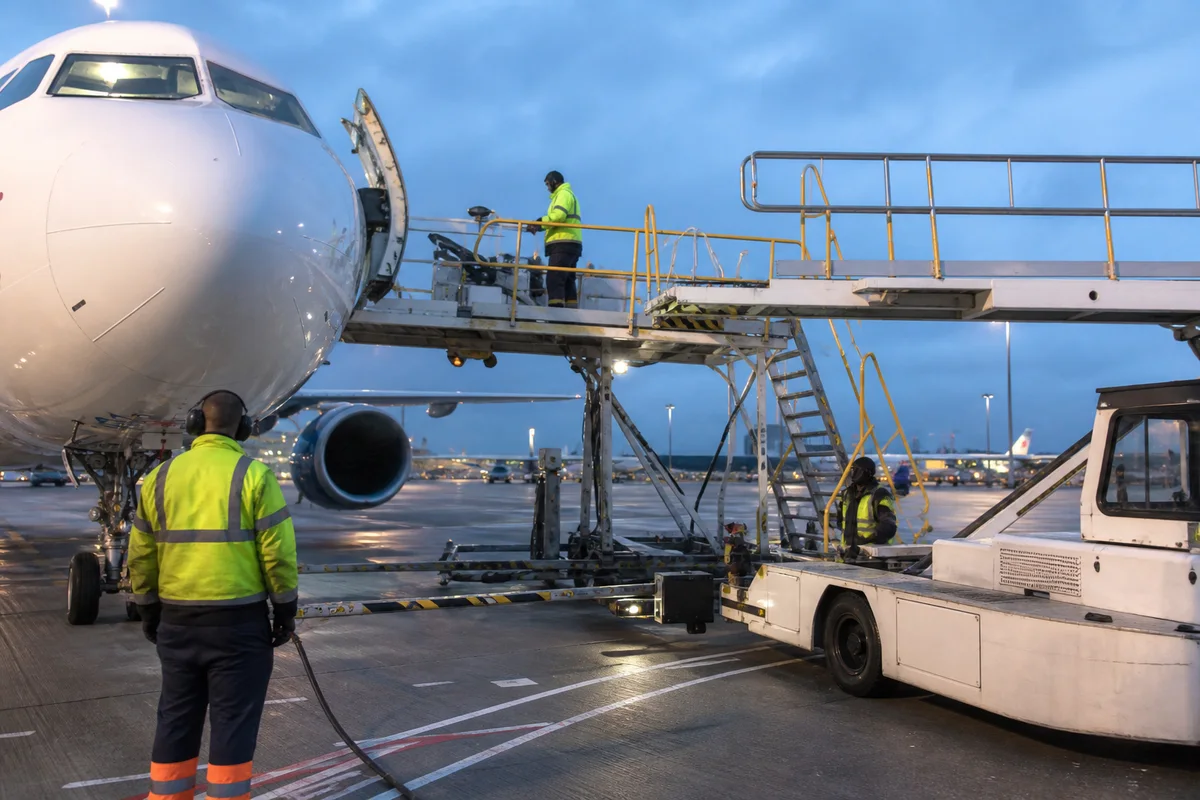
The client was selected by international airline to deliver passenger, ramp, cleaning and aircraft-turnaround support within live airport operations. Bid Champions supported the private pursuit through to contract award.
Client confidentiality Client identity and sensitive details are withheld; project facts are generalised only where needed to keep the case useful without identifying protected parties.
The pursuit had to make regional airline ground handling credible against close buyer scrutiny of airside safety, security, aircraft-turnaround performance, staffing, mobilisation, operational continuity and disruption recovery.
Bid Champions’ team supported the client’s winning private pursuit, applying the recorded operating model, mobilisation, safety and security, performance control and disruption recovery stages.
Award. Contract value: £10m+. The client retained a market reference for regional airline ground handling and the buyer-risk pattern behind it.
Work carried out by Bid Champions
The pursuit moved through five connected stages, with each decision tied to a practical output and the final submission.
airside safety, security, aircraft-turnaround performance, staffing, mobilisation, operational continuity and disruption recovery.
Operating model
Translated flight, passenger, ramp, cleaning or fuelling demand into a clear service design.
Project output A site and shift operating model.
Mobilisation
Planned vetting, passes, training, equipment, TUPE where relevant and staged readiness.
Project output A day-one mobilisation plan.
Safety and security
Traced hazards, permits, competence and airside controls to accountable owners.
Project output A safety-and-security control matrix.
Performance control
Defined turnaround, SLA, quality and customer reporting with corrective action.
Project output A KPI and governance schedule.
Disruption recovery
Showed how shortages, delays, weather and equipment failures are absorbed.
Project output Scenario-tested contingency responses.
It turns a private buyer’s commercial and operational concerns into a controlled answer, proof and negotiation route while preserving a controlled negotiation route.
Inside the buyer decision
Each card follows the same route: the risk, the work completed, the proof created and the effect on the decision.
Buyer decision
Operating reality
Commercial pressure
Stakeholder fit
Professional controls applied to the problem
These examples are tied to the work and outputs above, within the wider assurance approach used across the project.
These three APMP proposal-management practices shaped the requirement, evidence and release work for £10m+ Multi-year private-sector award for regional airline ground handling.
Translated flight, passenger, ramp, cleaning or fuelling demand into a clear service design. A site and shift operating model.
Planned vetting, passes, training, equipment, TUPE where relevant and staged readiness. A day-one mobilisation plan.
Traced hazards, permits, competence and airside controls to accountable owners. A safety-and-security control matrix.
These are three relevant examples from the broader project assurance—not the full set of controls applied.
For this £10m+ aviation and aerospace pursuit, a key driver was requirement ownership, evidence traceability, staged review and release control. It governed A KPI and governance schedule and directly addressed airside safety, security, aircraft-turnaround performance, staffing, mobilisation, operational continuity and disruption recovery.
For this £10m+ aviation and aerospace pursuit, a key driver was disruption scenarios, recovery ownership, minimum service and mobilisation readiness. It governed A day-one mobilisation plan and directly addressed airside safety, security, aircraft-turnaround performance, staffing, mobilisation, operational continuity and disruption recovery.
For this £10m+ aviation and aerospace pursuit, a key driver was risk identification, owned mitigations, dependencies and decision-stage review. It governed A KPI and governance schedule and directly addressed airside safety, security, aircraft-turnaround performance, staffing, mobilisation, operational continuity and disruption recovery.
This sequence connected the buyer’s concern to owned work, reviewable evidence and the final release decision.
How Bid Champions applies APMP and APM practiceHow standards support the pursuit
Why the bid won
It turns a private buyer’s commercial and operational concerns into a controlled answer, proof and negotiation route while preserving a controlled negotiation route.
The response built buyer confidence by addressing safety, security, airside competence, on-time performance, disruption recovery, trained labour, station-level management and credible mobilisation would have reduced operational risk. The winning pattern was a compliant and commercially acceptable response that converted those capabilities into a credible delivery case and reduced perceived execution risk.
What remained after submission
The client retained a market reference for regional airline ground handling and the buyer-risk pattern behind it.
Decision room · Aviation and aerospace · 3 decisions · About 60 seconds
Solve three connected pieces of the pursuit. Choose a route, then reveal what happened on this project.
The pursuit had to make regional airline ground handling credible against close buyer scrutiny of airside safety, security, aircraft-turnaround performance, staffing, mobilisation, operational continuity and disruption recovery.
Decision 1 of 3
Decision 01
What happened on the project Operating model. A site and shift operating model.
Decision 02
What happened on the project Safety and security. A safety-and-security control matrix.
Decision 03
What happened on the project Disruption recovery. Scenario-tested contingency responses.
What happened
It turns a private buyer’s commercial and operational concerns into a controlled answer, proof and negotiation route while preserving a controlled negotiation route.
Award. Contract value: £10m+. The client retained a market reference for regional airline ground handling and the buyer-risk pattern behind it.
Result£10m+ · Award
Facing a similar constraint?
We can test the buyer route, strengthen the bidder and offer, build the evidence and commercial case, write the response and control it through submission.