
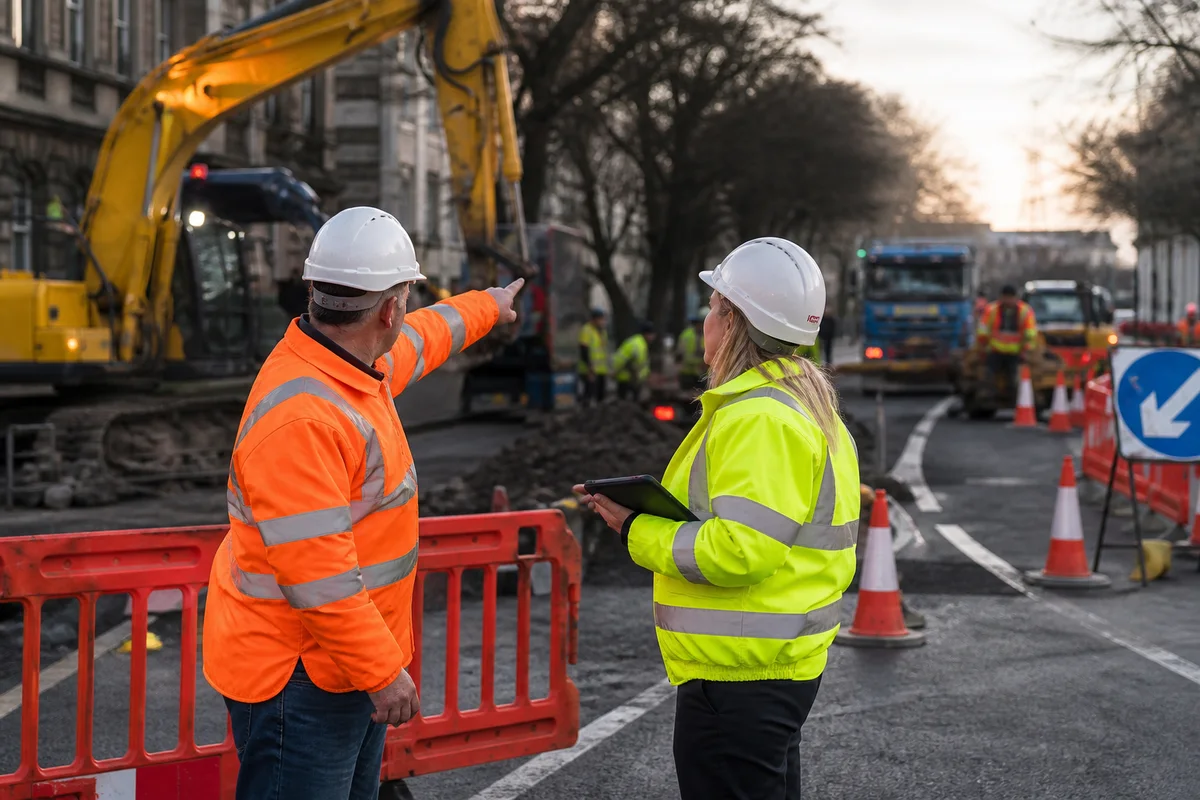
Sector pursuit field 45 · Built environment and property
Our basic working position: This is the first position we would test—not the final bid position. It changes with every buyer organisation, procurement or commercial team, evaluator group, operational user, budget owner and other stakeholder. The live opportunity, people, documents, conversations and clarifications determine the final pursuit.
Match the support to the pursuit
Start with the work the opportunity actually needs.
These are three useful routes—not a fixed package. The live documents, bidder position, deadline and buyer decision determine the final support.
Bid & Tender Writing
Write highways responses from approved network, traffic, safety, stakeholder and programme evidence.
See when to use this serviceEnd-to-End Bid Management
Control network, traffic, safety, stakeholder, programme and mobilisation workstreams in highways pursuits.
See when to use this serviceSocial Value & Carbon
Embed local employment, carbon, community and travel impacts into the delivery plan.
See when to use this servicePublic and private contract pursuit
Same capability. Different buying system.
A highways and traffic management pitch cannot be carried unchanged from a published public competition into a private sourcing decision. The solution may be similar, but authority, visibility, negotiation, risk appetite and the people shaping the decision can be very different.
Follow the declared route—and the decision behind it.
Start with the live notice, conditions, evaluation model, timetable, clarification rules and contract.
- Confirm road class, speed environment, authority, works type, design responsibility, statutory notices, permits, access windows and applicable code before selecting a method or competence claim.
- Separate framework admission from guaranteed work and distinguish capital schemes, term maintenance, specialist lots, technology operation and emergency call-offs in the resource and price model.
Find the real buying group and approval path.
Developers, utilities, event operators and infrastructure primes buy traffic management, street works and maintenance through project packages and call-off agreements.
- Establish who initiated the purchase, who owns the budget, who can veto it and how procurement, legal and finance will shape the agreement.
- Test incumbent relationships, negotiation room, approval gates, commercial risk and the evidence each decision-maker needs.
- Use conversations lawfully available in the process to refine the proposition; do not assume a private RFP reveals every deciding factor.
The “buyer” is rarely one person.
Align road users, network management, designers, utilities, police, contractors, communications and local communities.
Sector roles to test: Highway asset owner and engineer; Traffic manager and network operations; Road users, communities and accessibility representatives; Principal designer, principal contractor and safety leads; Commercial, programme and contract management.
The bidder is ready; the response needs precision.
Use focused writing when the highways and traffic management offer, price, delivery model, responsibilities and approved evidence already withstand challenge. We then align them to the question, stakeholder, evaluation logic and response architecture without pretending prose can repair the underlying business.
Find the route. Strengthen the bidder. Run the bid.
Use end-to-end management when suitable public or private opportunities need sourcing, private-buyer invitation positioning needs strengthening, or qualification, competitor intelligence, solution design, sourcing, pricing, partners, evidence and mobilisation still need work. Bid Champions runs the workload while the client retains concise go, price, risk and commitment approvals.
Candidate lifecycle movements: Shape → Prove → Decide → Deliver. Useful operating lenses to test include Vier-Augen-Prinzip, handover readiness and controlled evidence. They are selected proportionately; they are not certification claims or a substitute for the live contract.
Explore Achmed Esser's Assurance & Delivery Lattice →Relevant practice here can include bid/no-bid discipline, teaming, responsibility assignment, evidence-led writing, reviews and mobilisation. We apply the parts that fit the pursuit rather than forcing every competition through one template.
See APMP's winning-business lifecycle →Deliver an intervention inside a live network
Public evidence Highway, traffic-management and street-works legislation allocate functions around roads and network occupation. Department for Transport material separately addresses street-work coordination, signing and guarding, and traffic-sign practice; the documents have different scope and date boundaries. [ 001, 002, 003, 004, 005, 006 ]
Evidence-linked insight · What this changes The evaluable product is therefore not simply tonnes laid, signs installed or shifts covered. It is a justified change to a named asset while traffic, pedestrians, cyclists, adjacent services and authority decisions remain controlled, followed by an evidenced return to operation. [ 001, 002, 004, 008 ]
Where we would start first Write an intervention control sheet before the method statement. Identify the asset and defect, authority, design responsibility, users, road classification, permits, temporary arrangement, competent roles, inspection points, acceptance, record update and emergency fallback. Make programme and price follow that chain.
Keep construction, maintenance, traffic control and technology distinct
Public evidence The reviewed pipeline includes motorway traffic-management systems, bridges, flood-related engineering, resurfacing, restraint, road marking, signals, temporary traffic management and broader infrastructure works. These are related through the network but do not form one technical service category. [ 010, 011, 012, 013, 014 ]
Evidence-linked insight · What this changes A signal engineer, surfacing crew, bridge inspector and temporary traffic-management designer require different evidence, plant, access and acceptance. An umbrella highways credential can show organisational reach, but it cannot prove that the exact lot has competent people and available resources. [ 005, 010, 012, 013 ]
Where we would start first Create a work-type taxonomy covering design, inspection, planned works, reactive defect, winter, incident, technology, markings, restraint, signals, drainage and structures. Assign competence, standards, plant, test records, specialist partners, response and commercial units to each category; declare exclusions explicitly.
Authority and route determine the operating model
Public evidence National Highways' ATMS engagement concerns a strategic-road operating environment. Birmingham, Ealing, Derby and Lincolnshire records describe different framework, pipeline and select-list structures across city, borough and county work, including both broad programmes and specialist packages. [ 010, 011, 012, 013, 014 ]
Evidence-linked insight · What this changes Admission to a framework is not an instruction to mobilise, and a published ceiling is not demand. A national technology service, council term programme and specialist lot also distribute design, access, coordination, data, incident and supply-chain responsibilities differently. [ 010, 011, 013, 014 ]
Where we would start first Map the contracting authority, highway authority, traffic manager, works promoter, designer, principal contractor, maintenance owner and control-room interfaces. Confirm call-off mechanics, lot eligibility, forecast work, direct awards or competitions, geographic coverage, response classes and incumbent dependencies before committing capacity.
What stops a technically plausible bid winning
Public evidence The street-works safety code addresses signing, lighting and guarding but states exclusions for motorways and certain high-speed dual carriageways. The Traffic Signs Manual contains a separate Chapter 8 context, while current coordination guidance reflects recent permit, charge and penalty changes. [ 004, 005, 006 ]
Evidence-linked insight · What this changes A generic declaration of Chapter 8 compliance does not demonstrate the correct design for a particular road. Other common barriers are unverified quantities, optimistic road-space assumptions, missing buried-service data, no vulnerable-user route, vague engineering acceptance and a broad framework answer reused across unlike lots. [ 004, 005, 008, 012, 013 ]
Where we would start first Gate the pursuit on authority, road class, surveys, design maturity, traffic data, utilities, permits, possession windows, competence, materials, specialist capacity, testing, asset information and commercial risk. Record the evidence owner and due date for every condition; do not disguise exclusions as mobilisation detail.
A safe programme begins with controlled inputs
Public evidence The Highways Act, Traffic Management Act and street-works regime provide different statutory contexts. CDM duties concern construction roles and information, while equality legislation and street-work guidance reinforce the need to consider disabled and otherwise vulnerable road users in access arrangements. [ 001, 002, 003, 004, 007, 008 ]
Evidence-linked insight · What this changes An asset schedule does not reveal utility congestion, pedestrian demand, school times, bus operations, events, drainage behaviour or structural constraints. Those inputs affect safe design and productivity. When they are unresolved, the bidder needs explicit hold points and commercial assumptions rather than false precision. [ 004, 007, 008, 012 ]
Where we would start first Freeze a bid baseline containing asset inventory and condition, topographic and utility information, traffic and user profile, collision or incident context where supplied, standards hierarchy, design status, permits, stakeholder constraints, environmental limits, possession calendar, work quantities and record formats.
Build the road-space and work-package logic first
Public evidence The revised coordination code sets current expectations for managing street and road works, while buyer evidence shows programmes where multiple highway disciplines and delivery partners may compete for the same network windows and supporting resources. [ 006, 011, 013, 014 ]
Evidence-linked insight · What this changes A Gantt chart is credible only when each activity has an authority, information dependency, permit, access window and release condition. Programme float cannot cure a missing road-space decision or an unresolved utility conflict. Shared corridors also require cross-package integration rather than local optimisation. [ 002, 003, 006, 014 ]
Where we would start first Create a constraint-led programme linking survey, design, review, notices, permits, materials, crews, traffic arrangement, work, testing, reopening and record closure. Identify latest decision dates, contingency windows, incompatible works, diversion impacts and the named party able to authorise each change.
Acceptance must prove the asset and the network state
Public evidence Current authority records include condition services, resurfacing, road marking, restraint systems, signals, bridges and general engineering. These outputs use different physical tests and operational measures, even when they sit within the same framework or geographic programme. [ 011, 012, 013, 014 ]
Evidence-linked insight · What this changes Production volume is not acceptance. A closed job may still contain surface, geometry, drainage, marking, protection, software, documentation or reinstatement defects. Conversely, traffic delay needs context about approved occupation and incident conditions before it becomes evidence of contractor failure. [ 002, 003, 010, 013 ]
Where we would start first Build an inspection and test matrix for every work type. Specify hold and witness points, sample or full inspection, equipment and calibration, acceptance threshold, nonconformance route, defect responsibility, reopening authority and asset-data fields. Link payment to verified quantities and accepted outputs.
Road users and dutyholders shape the method
Public evidence Department for Transport guidance expressly includes disabled and vulnerable road users in street-work safety. CDM assigns project roles, while network-management legislation and the buyer records bring authority engineers, operations, structures, flood, signals and commercial teams into decisions. [ 002, 004, 007, 008, 012, 013 ]
Evidence-linked insight · What this changes The traffic manager can approve an occupation but may not accept a structural detail. A designer can specify a temporary arrangement but does not control a live incident. Residents, businesses, buses, emergency services, pedestrians and cyclists experience consequences that the works programme may not expose. [ 002, 004, 005, 008 ]
Where we would start first Map who owns asset need, design, road space, safety, stakeholder communication, permit, control-room decision, emergency response, test acceptance, payment and handback. Define escalation times and evidence. Test diversions and temporary routes with accessibility and local-operational perspectives before site release.
Make access and uncertainty visible in the price
Public evidence The procurement examples combine frameworks, prospective work and specialist pipelines. Their breadth may indicate opportunity, but it does not establish final quantities, task orders, access windows, material designs, traffic-management requirements or spend for a particular supplier. [ 011, 012, 013, 014 ]
Evidence-linked insight · What this changes Night work, short closures, escorting, setup, aborted possession, material temperature, weather, traffic management, utility risk and testing can dominate unit productivity. A headline rate built around continuous daytime access may be commercially incompatible with the buyer's actual network constraints. [ 003, 004, 006, 013 ]
Where we would start first Reconcile work quantities to design, traffic control, plant, crews, supervision, testing, disposal, data and overhead. State productivity assumptions by access type. Stress-test asphalt and bitumen, fuel, labour, specialist supply, weather and standby, then define compensation-event and abortive-occupation rules.
Prove readiness through first-work controls
Public evidence The current notices span multi-partner frameworks and highly specialist technology and highway activities. Statutory and DfT sources add role, coordination and temporary-management duties that must operate from the first network intervention, not after a mobilisation learning period. [ 002, 004, 006, 007, 010, 014 ]
Evidence-linked insight · What this changes Mobilisation should reconcile the authority's asset, permit and incident systems with supplier delivery. A depot, workforce and software login do not establish safe commencement. First works are valuable calibration points for design information, productivity, inspections, user communication and record handback. [ 006, 010, 011, 014 ]
Where we would start first Select representative first works by risk and discipline. Complete joint asset checks, design and permit review, competence verification, dry-run communications, traffic-arrangement inspection, materials readiness and emergency rehearsal. Hold a structured after-action review before increasing geographic or work-type volume.
Design for workers, road users and network recovery
Public evidence Street-work safety material covers signing, lighting and guarding within its scope; the Traffic Signs Manual provides wider traffic-sign guidance; CDM addresses construction management; and equality law provides a broader statutory context for authority and access decisions. [ 004, 005, 007, 008 ]
Evidence-linked insight · What this changes Safety evidence needs to cover setup, live operation, change, inspection, removal and emergency conditions. A compliant drawing can be defeated by poor placement, queuing, weather, equipment failure or an unexpected user movement. Technology failure may also affect network control and recovery. [ 004, 005, 010 ]
Where we would start first Show the task hazard record, temporary design, installation check, inspection frequency, queue and pedestrian monitoring, change authority, incursion response, emergency access, severe-weather rule and failure fallback. For connected systems, include privilege, update, logging, continuity and safe-degraded-operation controls.
Control specialist and shared-network dependencies
Public evidence Buyer evidence identifies specialist activities including signals, restraint, markings, structures, flood work and ATMS, as well as wider frameworks involving delivery partners. Each may depend on proprietary equipment, competent installers, laboratories, traffic providers or scarce plant. [ 010, 012, 013, 014 ]
Evidence-linked insight · What this changes A partner list does not demonstrate availability in a closure window or compatibility with the authority's asset. Interfaces fail when design responsibility, permits, data, equipment lead times, testing and defect ownership are split across organisations without a controlled handoff. [ 006, 010, 013, 014 ]
Where we would start first Create an interface register by work package. Record design scope, competence, reserved capacity, geographic response, plant, materials, system access, test evidence, information exchange, substitution, warranty and emergency escalation. Exercise one end-to-end handoff before relying on it in the delivery plan.
Measure safety, availability, quality and information separately
Public evidence The reviewed opportunities encompass operational technology, condition services, construction and specialist highway assets. Network-management and street-works coordination sources add occupation and operational context, so one aggregate completion measure would conceal materially different results. [ 002, 006, 010, 012, 013 ]
Evidence-linked insight · What this changes A programme can be on time while reopening with defects; an asset can pass a test while the occupation causes avoidable disruption; a responsive defect team can still leave poor records. Measures should preserve those layers and trigger the correct technical or operational remedy. [ 002, 006, 012, 014 ]
Where we would start first Define measures for incidents, temporary-arrangement findings, permit compliance, occupation, first-time acceptance, defects, response, availability, journey or user impact where attributable, asset-data completeness and commercial forecast. Publish calculation, population, exclusions, source system, frequency, threshold and accountable owner.
Red-team the interfaces where highway bids fail
Public evidence Public sources establish legal context and current buying activity but do not validate a bidder's surveys, design, plant, crews, safe systems, materials, software, response or performance. These are bid-specific proof requirements rather than facts that can be inferred from the market. [ 001, 004, 006, 010, 011, 012, 013, 014 ]
Evidence-linked insight · What this changes Weakness usually appears between functions: asset need without survey, design without road space, permit without buildable sequence, work without acceptance, reopening without records, or framework breadth without specialist capacity. Each broken interface creates safety, schedule and commercial exposure simultaneously. [ 002, 003, 006, 007 ]
Where we would start first Choose a complex representative intervention and trace it from defect through survey, design, stakeholder decision, permit, materials, traffic arrangement, construction, testing, opening, data update, invoice and warranty. Assign every discontinuity to an engineer, operator, commercial owner or partner for closure.
Bid structure cannot substitute for engineering authority
Public evidence The cited Acts and DfT documents require current applicability decisions. The safety code's explicit road exclusions demonstrate why a public reference must not be converted into an undifferentiated compliance promise. Local permits, standards and project documents remain controlling. [ 001, 002, 003, 004, 005, 006, 007, 008, 009 ]
Evidence-linked insight · What this changes Pursuit support can clarify requirements, expose assumptions, organise proof, stress-test delivery and create an evaluator-friendly trace. It cannot approve a highway design, select a traffic arrangement, certify an operative, grant road space or validate an unrecorded safety outcome. [ 004, 005, 006, 007 ]
Where we would start first Use Bid Champions for pursuit governance, evidence architecture, challenge and writing. Keep chartered and competent highway, structures, traffic-management, street-works, road-safety, accessibility, CDM, commercial, legal and procurement professionals accountable for decisions that require their authority and retain their signed records.
Return usable asset and decision records
Public evidence Highway and traffic-management functions continue after each work order, and the current buyer records concern long-lived networks, frameworks and operational systems. Coordination, inspection and future intervention depend on reliable records beyond a supplier's contract term. [ 001, 002, 006, 010, 011, 014 ]
Evidence-linked insight · What this changes An incomplete handback transfers hidden risk to future designers and crews. Drawings without status, test results without asset identifiers, or proprietary codes without definitions weaken maintenance and force repeat survey. Operational technology adds configuration, licence and access dependencies to the physical record. [ 007, 010, 012 ]
Where we would start first Provide verified asset identifiers, surveys, designs, approvals, permits, material and test records, as-builts, photographs, defects, warranties, configuration, software and access records, maintenance requirements and open risks in agreed portable formats. Train buyer users and test retrieval before final acceptance.
Distinguish statutory context, market signals and delivery proof
Public evidence Nine official, government or regulator sources define the research context, and five contracting-authority records demonstrate recent market scope. None is a case study of the prospective bidder or evidence that Bid Champions produced a highway result. [ 001, 002, 003, 004, 005, 006, 007, 008, 009, 010, 011, 012, 013, 014 ]
Evidence-linked insight · What this changes A notice can support the statement that an authority sought a capability on a stated date. It cannot prove contract delivery, demand, safety or outcome. Supplier claims need approved evidence with comparable scope, baseline, period, result, attribution and limitations. [ 010, 011, 012, 013, 014 ]
Where we would start first Maintain separate evidence classes for law and guidance, procurement examples, certifications, equipment, named people, partner capability, past performance and client-approved outcomes. Give each claim a source, owner, permission and expiry. Replace absent outcome proof with a precise validation plan.
Relevant award story
£10m+ public-sector award for highway maintenance and improvements
An anonymised Bid Champions client was selected by Unitary council to provide highway maintenance and improvements. The public award record supports the clear value marker £10m+.
- Buyer
- Unitary council
- Contract value
- £10m+
- Outcome
- Contract award recorded
The precise tender-support workstream is confidential. The full case separates Bid Champions’ recorded support, the client’s solution and commitments, and the buyer’s award decision.
Read the complete case studyLive-pursuit check
What we would verify before fixing the strategy.
For a live opportunity, we would recheck the applicable law and standards, the buyer's latest notice and documents, qualification route, amendments, commercial assumptions and delivery conditions. This keeps the analysis useful without treating a general market position as a substitute for the actual competition.
Priority public records to recheck: Safety at street works and road works; Traffic signs manual; Co-ordinating street works and works for road purposes; OCAMS093 ATMS Provider; P1228 Highways and Infrastructure Works Framework; Highways Framework Pipeline Notice.
Independent verification checks
The public references supporting the evidence points above remain available so a bidder, specialist or decision-maker can test the position against the original authority.
Open 14 public references used to test this sector position
- Highways Act 1980 — The National Archives
- Traffic Management Act 2004 — The National Archives
- New Roads and Street Works Act 1991 — The National Archives
- Safety at street works and road works — Department for Transport
- Traffic signs manual — Department for Transport
- Co-ordinating street works and works for road purposes — Department for Transport
- Construction (Design and Management) Regulations 2015 — The National Archives
- Equality Act 2010 — The National Archives
- Procurement Act 2023 — The National Archives
- OCAMS093 ATMS Provider — National Highways Limited
- P1228 Highways and Infrastructure Works Framework — Birmingham City Council
- Highways and Transport Services Framework: Preliminary Market Engagement — London Borough of Ealing
- Highways Framework Pipeline Notice — Derby City Council
- Highways Select List Framework — Lincolnshire County Council