
Sector pursuit field 51 · Energy, environment and utilities
Our basic working position: This is the first position we would test—not the final bid position. It changes with every buyer organisation, procurement or commercial team, evaluator group, operational user, budget owner and other stakeholder. The live opportunity, people, documents, conversations and clarifications determine the final pursuit.
Match the support to the pursuit
Start with the work the opportunity actually needs.
These are three useful routes—not a fixed package. The live documents, bidder position, deadline and buyer decision determine the final support.
Bid & Tender Writing
Write environmental-consultancy answers from approved method, specialist, stakeholder and reporting evidence.
See when to use this serviceEnd-to-End Bid Management
Coordinate method, specialist input, evidence, stakeholder and mobilisation workstreams in environmental commissions.
See when to use this serviceSocial Value & Carbon
Connect environmental outcomes to measurable implementation rather than generic sustainability wording.
See when to use this servicePublic and private contract pursuit
Same capability. Different buying system.
A environmental consultancy and services pitch cannot be carried unchanged from a published public competition into a private sourcing decision. The solution may be similar, but authority, visibility, negotiation, risk appetite and the people shaping the decision can be very different.
Follow the declared route—and the decision behind it.
Buyer settings evidenced in the sector dossier: Transport for London; UK Atomic Energy Authority; UK Research & Innovation.
Start with the live notice, conditions, evaluation model, timetable, clarification rules and contract.
- Start with a service-boundary matrix: decision to support, activity, location, receptor, applicable regime, output, author, checker, approving authority and residual exclusion. Select examples discipline by discipline. A sustainability commission or generic environmental policy is not evidence that the team can perform intrusive investigation, statutory assessment or expert-witness work.
- Trace the latest notice version and procurement documents before committing resources. Confirm procedure, lot, call-off mechanism, appointment model, selection limits, turnover or insurance conditions, evaluation method, conflicts rules and timetable. Keep indicative values separate from likely task orders and record every assumption that could change resourcing or price.
Find the real buying group and approval path.
Developers, lenders, insurers and industrial operators commission assessments, permits, monitoring and remediation advice through panels and project appointments.
- Establish who initiated the purchase, who owns the budget, who can veto it and how procurement, legal and finance will shape the agreement.
- Test incumbent relationships, negotiation room, approval gates, commercial risk and the evidence each decision-maker needs.
- Use conversations lawfully available in the process to refine the proposition; do not assume a private RFP reveals every deciding factor.
The “buyer” is rarely one person.
Align project sponsors, technical specialists, legal, planning, finance, operations and affected communities.
Sector roles to test: Transport for London; UK Atomic Energy Authority; UK Research & Innovation; Oxford Direct Services Limited; client technical, commercial, legal and governance owners.
The bidder is ready; the response needs precision.
Use focused writing when the environmental consultancy and services offer, price, delivery model, responsibilities and approved evidence already withstand challenge. We then align them to the question, stakeholder, evaluation logic and response architecture without pretending prose can repair the underlying business.
Find the route. Strengthen the bidder. Run the bid.
Use end-to-end management when suitable public or private opportunities need sourcing, private-buyer invitation positioning needs strengthening, or qualification, competitor intelligence, solution design, sourcing, pricing, partners, evidence and mobilisation still need work. Bid Champions runs the workload while the client retains concise go, price, risk and commitment approvals.
Candidate lifecycle movements: Discover → Shape → Prove → Deliver. Useful operating lenses to test include Nachweisführung, continuous improvement and controlled handover. They are selected proportionately; they are not certification claims or a substitute for the live contract.
Explore Achmed Esser's Assurance & Delivery Lattice →Relevant practice here can include opportunity qualification, competitive positioning, solution proof, risk review and implementation planning. We apply the parts that fit the pursuit rather than forcing every competition through one template.
See APMP's winning-business lifecycle →Environmental procurement is a portfolio of specialist decisions
Evidence-linked insight · What this changes Reviewed opportunities span environmental assessment, monitoring, sampling, waste advice, climate analysis and building-refurbishment support. The Transport for London framework alone separates ecology, noise, air quality, adaptation and other disciplines into defined lots. Similar labels therefore conceal different liabilities, methods, field seasons and deliverables. [ 014, 015, 016, 017 ]
Where we would start first Start with a service-boundary matrix: decision to support, activity, location, receptor, applicable regime, output, author, checker, approving authority and residual exclusion. Select examples discipline by discipline. A sustainability commission or generic environmental policy is not evidence that the team can perform intrusive investigation, statutory assessment or expert-witness work. [ 014, 015, 016, 017 ]
Notice stage and commercial vehicle change the pursuit
Public evidence The sample includes preliminary market engagement, a tendered framework, contract details after signature and a below-threshold direct contract. A framework maximum is not promised work, preliminary engagement is not a tender, and a signed-contract notice is not independent evidence of satisfactory delivery. [ 001, 002, 014, 015, 016, 017 ]
Where we would start first Trace the latest notice version and procurement documents before committing resources. Confirm procedure, lot, call-off mechanism, appointment model, selection limits, turnover or insurance conditions, evaluation method, conflicts rules and timetable. Keep indicative values separate from likely task orders and record every assumption that could change resourcing or price. [ 001, 002, 014, 015, 016, 017 ]
Advisory scope must not drift into unpriced responsibility
Evidence-linked insight · What this changes Screening advice, a permit risk assessment, an Environmental Statement chapter, a site investigation, laboratory coordination and construction monitoring answer different questions. They can feed one programme, but none automatically includes design ownership, legal interpretation, application submission, regulator negotiation, remediation supervision or long-term performance verification. [ 005, 006, 010, 011, 012, 014 ]
Where we would start first Define inputs, reliance, spatial boundary, assessment year, scenarios, survey coverage, deliverable status, consultation allowance, revision rounds and decisions reserved to the client or authority. Show change control for newly discovered receptors, design movement, abnormal contamination, regulator requests and delayed access rather than silently absorbing these risks. [ 005, 006, 010, 011, 012 ]
Territory, authority and activity determine the rule set
Evidence-linked insight · What this changes Planning, environmental permitting, habitats protection and contaminated-land controls have territorial, activity and decision-maker boundaries. An English planning-policy document does not establish requirements in Scotland, Wales or Northern Ireland. Even within England, the planning authority, environmental regulator, landowner and statutory consultees hold different functions. [ 003, 004, 005, 006, 007, 009, 013 ]
Where we would start first Build a live applicability register naming site, jurisdiction, proposal, consent, permit holder, competent authority, regulator and source version. Obtain specialist legal or regulatory advice where the position is uncertain. Never turn a guidance summary into a universal legal conclusion, and distinguish mandatory duties from policy, standards and buyer preferences. [ 003, 004, 005, 006, 007, 009, 013 ]
Screening, scoping and assessment are separate evidence steps
Public evidence The Environmental Impact Assessment Regulations and planning guidance establish a formal context for determining whether assessment is required and what it should cover. Strategic Environmental Assessment, project EIA, habitats assessment and topic studies are not synonyms, and the relevant authority retains its statutory decision. [ 006, 007, 009, 010 ]
Where we would start first Provide a proportionate pathway from project description and constraints through screening evidence, scope, baseline, alternatives, effects, mitigation and residual effects. Record consultations and unresolved positions. Do not promise consent or say that a consultant's screening view binds the authority; state exactly which submission the team will prepare and support. [ 006, 007, 010 ]
Permit support needs an operator-owned compliance boundary
Evidence-linked insight · What this changes Environmental-permit risk assessment can require conceptual models, emissions appraisal, accident scenarios and receptor evaluation. The adviser may prepare evidence, yet the operator owns operational truth and the regulator determines the application. A technically complete draft neither guarantees permit grant nor removes continuing compliance obligations. [ 004, 005, 011 ]
Where we would start first Identify regulated facility, activity, operator, existing authorisations, variations, emissions, sensitive receptors and data gaps. Allocate responsibility for operating techniques, management systems, modelling, application forms, responses and post-grant controls. Maintain a compliance-assumption log so proposed conditions, operational limits and unresolved regulator questions are visible in the bid. [ 004, 005, 011 ]
Land risk depends on source, pathway and receptor evidence
Public evidence Environment Agency land-contamination risk management guidance describes a staged approach, while statutory contaminated-land guidance serves a particular legal regime. Planning development, voluntary remediation, permit surrender and formal contaminated-land determination can demand different evidence and decision thresholds. Historical use alone does not prove unacceptable risk. [ 004, 005, 012, 013 ]
Where we would start first Set out the conceptual site model, uncertainty, investigation rationale, sampling design, laboratory schedule, quality controls, assessment criteria and remediation verification route. Keep ground risk, waste classification, geotechnical conditions and occupational exposure connected but separately governed. Flag access constraints and unexpected contamination as programme and commercial triggers. [ 004, 005, 012, 013 ]
Sampling credibility starts before the field visit
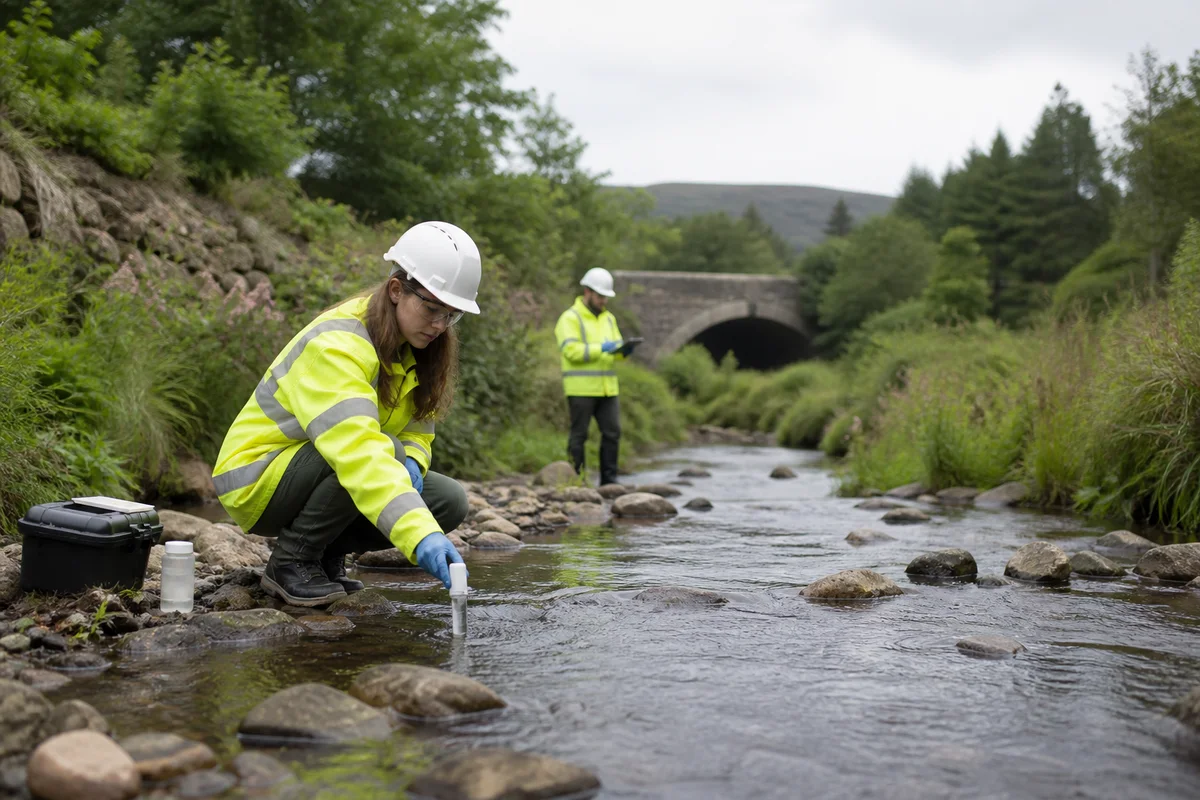
Evidence-linked insight · What this changes The UK Atomic Energy Authority engagement notice includes field sampling, laboratory coordination, reporting and regulatory or quality compliance. That chain makes representativeness, location control, equipment suitability, contamination prevention, preservation, transport, custody and method detection limits material rather than administrative details. [ 015 ]
Where we would start first Provide a sampling-and-analysis plan linked to the decision being made. Name competent roles, method references, containers, blanks, duplicates, calibration, custody records, holding times, accredited laboratory scope, validation rules and non-conformance handling. State where access, weather, process state or sample volume could limit interpretation. [ 011, 012, 015 ]
A baseline must be decision-fit, dated and reproducible
Evidence-linked insight · What this changes Environmental baselines can combine records, monitoring, surveys, imagery, asset data and stakeholder knowledge. Their fitness depends on coverage, date, resolution, methods and the proposal assessed. A large dataset may still be unsuitable if it misses seasonal conditions, extreme events, construction phases or the affected receptor population. [ 006, 010, 011, 012, 014 ]
Where we would start first Create a baseline register with source owner, licence, capture date, coordinate system, quality status, gap, intended use and update rule. Separate observed conditions from inferred or modelled values. Show how surveys, monitoring and consultation close priority gaps, and define the design freeze that triggers reassessment. [ 006, 010, 011, 012, 014 ]
Models support judgement; they do not replace it
Evidence-linked insight · What this changes Air, noise, flood, climate, transport and contaminant models transform assumptions and data into decision evidence. Results depend on model selection, domain, inputs, calibration, validation, sensitivity and scenario definition. Precision in an output table cannot cure weak source data or an inappropriate conceptual model. [ 006, 010, 011, 014 ]
Where we would start first Describe model purpose, version, competence, data provenance, checks, limitations and approval route. Provide scenario and sensitivity logic, not only a headline result. Use independent technical review where consequence warrants it, retain reproducible input and output sets, and explain uncertainty in language that a decision-maker can act upon. [ 006, 010, 011, 014 ]
Effects and mitigation need ownership through delivery
Evidence-linked insight · What this changes An assessment commonly moves from baseline and impact pathway to magnitude, receptor sensitivity, significance, mitigation and residual effect. These judgements may be discipline-specific. A mitigation commitment is only credible when it is technically feasible, designed, consent-compatible, funded, programmed and assigned to an accountable delivery party. [ 003, 006, 007, 008, 010, 014 ]
Where we would start first Maintain a commitments register linking each effect to avoidance, reduction, remedy or monitoring action; design reference; owner; timing; acceptance evidence; and residual risk. Reconcile it with cost, programme, construction plans and consent documents. Escalate measures dependent on land, third parties or authority agreement instead of presenting them as secured. [ 003, 006, 007, 008, 010 ]
Topic interfaces determine whether the assessment coheres
Evidence-linked insight · What this changes Ecology, landscape, heritage, water, noise, air, carbon, health, transport and ground conditions can share receptors and mitigation. Without interface control, teams may use different project descriptions, assessment years or construction assumptions, and may double count benefits or miss combined effects. [ 006, 007, 010, 014 ]
Where we would start first Set one controlled project description, assumptions register, receptor map, design-change process and chapter interface schedule. Name an integration lead and technical approvers. Run consistency checks across drawings, scenarios, terminology, significance, mitigation and appendices before issue, with discrepancies logged and resolved rather than edited invisibly. [ 006, 007, 010, 014 ]
Consultation evidence must distinguish engagement from agreement
Evidence-linked insight · What this changes Authorities, regulators, statutory bodies, landowners, communities and technical stakeholders may supply evidence or influence scope, but their interests and powers differ. A meeting, email or absence of objection does not necessarily constitute consent, approval or acceptance of a mitigation proposal. [ 005, 006, 007, 010, 011 ]
Where we would start first Use a stakeholder-and-consent matrix recording statutory role, topic, question, information issued, response, action owner, due date and formal status. Quote positions accurately and preserve the correspondence trail. Price consultation assumptions and extra response rounds; reserve decisions that only the applicant, operator or authority can make. [ 005, 006, 007, 010, 011 ]
Construction controls must convert reports into field decisions
Evidence-linked insight · What this changes The current TfL scope includes environmental monitoring for construction and expert-witness capability in specialist lots. Delivery may require inspections, briefings, trigger levels, incident response, evidence capture and escalation, not merely an approved pre-construction report. Site conditions can invalidate earlier assumptions. [ 008, 014 ]
Where we would start first Translate commitments into method statements, hold points, inspection plans, monitoring locations, thresholds and stop-or-escalate authority. Define reporting lines between environmental adviser, designer, principal contractor, client and regulator. Record deviations, corrective actions and close-out evidence, with emergency arrangements proportionate to the possible harm. [ 005, 008, 014 ]
Environmental data must remain traceable after handover
Evidence-linked insight · What this changes Consultancy outputs can combine personal data, licensed records, laboratory results, geospatial layers, photographs, model files and client-confidential plans. Reliability and reuse depend on provenance, permissions, versioning, coordinate reference, metadata and retention. A polished PDF without its evidence chain is a fragile asset. [ 012, 014, 015 ]
Where we would start first Propose a controlled common data environment with naming, status, review, access, backup and archive rules. Deliver native data and metadata where rights allow, alongside assumptions and read-me files. Identify third-party licence limits at bid stage and agree what the client can disclose, update and rely on after appointment. [ 012, 014, 015 ]
Review must be competent and sufficiently independent
Evidence-linked insight · What this changes Environmental conclusions can affect consent, public safety, cost and reputation. Self-checking alone may be inadequate where methods are novel or consequence is high. Conflicts can also arise when one party promotes design, assesses it, verifies mitigation and reports success without transparent safeguards. [ 006, 008, 010, 011, 014 ]
Where we would start first Provide named author, checker and approver roles with discipline competence, conflict declarations and review depth matched to risk. Separate calculation check, editorial review and independent technical challenge. Keep decision logs and comment resolution visible, and describe how a material disagreement reaches the client rather than being suppressed. [ 006, 008, 010, 011 ]
Field seasons and authority response times are critical path
Evidence-linked insight · What this changes Survey windows, land access, laboratory turnaround, design maturity, consultation periods and regulator responses constrain environmental programmes. Missing an ecological, hydrological or operational window can defer reliable evidence far beyond a normal report-writing allowance. Concurrent drafting does not remove dependency on valid inputs. [ 006, 007, 011, 012, 014, 015 ]
Where we would start first Submit a dependency-led programme showing access, surveys, data receipt, design freezes, consultation, review, submission and contingency. State client decisions and response assumptions. Use early-warning rules for missed windows or changing design, plus recovery options that explain evidence limitations rather than claiming an equivalent survey can always be improvised. [ 006, 007, 011, 012, 014, 015 ]
CV coverage must match tasks, licences and peak demand
Evidence-linked insight · What this changes A broad environmental framework can call for discipline leads, field teams, analysts, modellers, GIS specialists, planners, technical reviewers and expert witnesses. Organisation-level experience does not show that named people are available, appropriately qualified, authorised for restricted activities or able to cover simultaneous commissions. [ 014, 015 ]
Where we would start first Map named roles to deliverables, competencies, licences, locations, availability and deputies. Show mobilisation lead time and surge capacity without double-booking individuals. For subcontractors, include appointment status, quality controls, data exchange, insurance, conflicts and substitution rules; do not describe an uncommitted specialist as secured capacity. [ 014, 015, 016 ]
Price the evidence pathway, not a generic report
Evidence-linked insight · What this changes Environmental appointments may use lump sums, schedules of rates, task orders, day rates or capped fees. Exposure grows when access, survey effort, laboratory tests, modelling iterations, consultation, travel, hearings and design revisions are undefined. A low headline fee can simply transfer uncertainty into exclusions and variations. [ 014, 015, 016, 017 ]
Where we would start first Build price from deliverables, resource grades, field effort, equipment, laboratories, licences, travel, review and programme. State quantities and dependencies, separate optional services, and align rates with the call-off model. Use explicit compensation or change events for client delay, changed scope, repeat surveys and authority-driven revision. [ 014, 015, 016, 017 ]
Mobilisation should expose unknowns before they become defects
Evidence-linked insight · What this changes Early failure often comes from unclear project description, missing access, unavailable source files, inconsistent coordinates, late specialist appointment or misunderstood authority expectations. These conditions affect every subsequent baseline, model and assessment. Mobilisation is therefore an evidence audit, not merely a kick-off meeting. [ 006, 011, 012, 014, 015 ]
Where we would start first Offer a first-phase mobilisation pack covering scope confirmation, data room, site and access plan, consent map, stakeholder list, design baseline, assumptions, risks, programme, document controls and immediate surveys. Assign closure owners and dates. Report unresolved inputs with consequence and mitigation before accepting dependent milestones. [ 006, 011, 012, 014, 015 ]
Evaluators need a visible chain from method to decision
Evidence-linked insight · What this changes Current procurements demonstrate varied scales and procedures, so no standard scoring formula can be assumed. Nevertheless, a credible response usually lets an evaluator locate the requirement, proposed method, accountable role, control, output, timetable and evidence. General enthusiasm is hard to verify against technical questions. [ 014, 015, 016, 017 ]
Where we would start first Create a compliance-and-evidence matrix against the actual question set. Use requirement-specific headings, named artefacts and bounded proof. Reconcile narrative with programme, organisation chart and pricing schedule. Run technical, commercial and evaluator-read reviews, retaining challenges where a claim lacks a source, owner or feasible delivery mechanism. [ 001, 002, 014, 015, 016, 017 ]
Outcome measures must not confuse activity with effect
Evidence-linked insight · What this changes Reports delivered, samples collected and meetings held measure output. Better environmental decisions, reduced exposure, consent-ready evidence or effective mitigation are outcomes, but attribution may be shared and delayed. A consultant cannot guarantee authority decisions, absence of incidents or ecosystem response solely through advice. [ 003, 005, 006, 008, 011, 015 ]
Where we would start first Use a balanced measure set: timeliness, first-time quality, data completeness, issue closure, mitigation implementation, threshold exceedance and decision acceptance, each with baseline, definition, owner and evidence source. Describe dependencies and contribution. Avoid unsupported percentages and keep environmental performance claims separate from procurement success. [ 003, 005, 006, 008, 011 ]
Consortiums need one integrated technical authority
Evidence-linked insight · What this changes Multi-lot and multidisciplinary commissions create legitimate routes for specialist subcontractors and consortiums. They also create interface risk around inconsistent methods, duplicated mobilisation, data formats, insurance, ownership and review. A collection of logos does not demonstrate an operable delivery system. [ 014, 015 ]
Where we would start first Define prime and specialist responsibilities through a deliverable RACI, common standards, shared assumptions, design-change notice, data protocol and escalation route. Evidence previous joint working only where verifiable. State which organisations are committed and which remain proposed, including replacement and continuity arrangements. [ 014, 015, 016 ]
Common weaknesses are testable before submission
Evidence-linked insight · What this changes Typical failure modes include treating all environmental work as equivalent, copying legislation without applying it, omitting field limitations, claiming consent certainty, presenting model outputs without lineage, leaving mitigation unowned, using non-committed specialists, and pricing an unrealistically fixed scope. Each weakness breaks a specific evidence link. [ 003, 005, 006, 011, 012, 014, 015 ]
Where we would start first Run a red-team review against boundaries, authority, baseline, competence, uncertainty, interfaces, deliverability, commercials and proof. Convert each material challenge into a corrected response, qualified statement, evidence request or visible risk. Do not fill an evidence gap with invented certifications, project results, permissions or client endorsements. [ 003, 005, 006, 011, 012, 014, 015 ]
A Bid Strengthening Plan should close environmental evidence gaps
Where we would start first Prioritise opportunity-specific actions: freeze the assessed project description; validate legal and policy applicability; confirm access and survey windows; appoint specialist leads; audit baseline and modelling inputs; map consents; secure laboratory and subcontractor capacity; reconcile mitigation with design, programme and cost; and evidence review governance. [ 003, 005, 006, 007, 011, 012, 014, 015 ]
Where we would start first Give every action an owner, deadline, acceptance test, dependency and fallback. Link it to the tender question and decision risk it strengthens. Keep unresolved red items in the submission decision record. This creates retained capability because the registers, methods and controls can support delivery, not only bid prose. [ 014, 015, 016, 017 ]
Proof must match discipline, decision and delivery stage
Evidence-linked insight · What this changes A contract notice proves a procurement record, not a supplier's technical result. Strong project evidence identifies comparable service, jurisdiction, constraint, named role, method, controlled output and attributable result, with client permission. Accreditation or membership proves only its documented scope and current status. [ 014, 015, 016, 017 ]
Where we would start first Build a proof ledger with source file, owner, date, scope, permission, claim supported and limitations. Use redacted deliverables, auditable metrics or references where authorised. Until those records are verified and approved, retain explicit placeholders or bounded capability statements rather than publishing fabricated case studies or performance figures. [ 014, 015, 016, 017 ]
The client retains choices that advice cannot make
Evidence-linked insight · What this changes The client or operator retains appetite for cost and programme, project design, application strategy, operational commitments, acceptance of residual risk and instructions to submit. Authorities and regulators retain statutory determinations. The consultant can frame evidence and consequences but cannot legitimately promise those external decisions. [ 005, 006, 007, 010, 011 ]
Where we would start first Include a decision schedule specifying options, recommendation, evidence, consequence, decision owner and last responsible date. Escalate non-decisions before they compromise surveys or submission. Record the agreed basis and update it on change; do not conceal client-held risk inside an unconditional consultant outcome promise. [ 005, 006, 007, 010, 011 ]
Handover should leave a maintainable environmental record
Evidence-linked insight · What this changes Environmental evidence often outlives the appointment and may support construction, operation, future variation, audit or enforcement. Value is lost when assumptions, raw data, model versions, commitments and authority correspondence cannot be found or reproduced after team changes. [ 005, 006, 008, 011, 012, 014 ]
Where we would start first Specify an indexed handover containing controlled reports, native data, metadata, models, licences, sampling records, consultation log, commitments, monitoring plan, open issues and update instructions. Confirm intellectual-property and third-party restrictions. Hold a knowledge-transfer review and test that the client can locate, interpret and maintain critical artefacts. [ 005, 006, 008, 011, 012, 014 ]
Relevant award story
£100k+ public-sector award for central-government environmental consultancy
An anonymised Bid Champions client was selected by Central government shared-services body to provide central-government environmental consultancy. The public award record supports the clear value marker £100k+.
- Buyer
- Central government shared-services body
- Contract value
- £100k+
- Outcome
- Contract award recorded
The precise tender-support workstream is confidential. The full case separates Bid Champions’ recorded support, the client’s solution and commitments, and the buyer’s award decision.
Read the complete case studyLive-pursuit check
What we would verify before fixing the strategy.
For a live opportunity, we would recheck the applicable law and standards, the buyer's latest notice and documents, qualification route, amendments, commercial assumptions and delivery conditions. This keeps the analysis useful without treating a general market position as a substitute for the actual competition.
Priority public records to recheck: TfL Professional Services Frameworks 3: Transport Planning and Impact Monitoring and Environmental Services; PME for Crop Sampling and Environmental Sampling (2 Lots); UKRI-5486 Edinburgh 1894 Building - Sustainability and Environmental Consultancy; Waste and Environmental Consultancy Services.
Independent verification checks
The public references supporting the evidence points above remain available so a bidder, specialist or decision-maker can test the position against the original authority.
Open 17 public references used to test this sector position
- Procurement Act 2023 — UK Parliament / legislation.gov.uk
- Procurement Regulations 2024 — UK Parliament / legislation.gov.uk
- Environment Act 2021 — UK Parliament / legislation.gov.uk
- Environmental Protection Act 1990 — UK Parliament / legislation.gov.uk
- Environmental Permitting (England and Wales) Regulations 2016 — UK Parliament / legislation.gov.uk
- Town and Country Planning (Environmental Impact Assessment) Regulations 2017 — UK Parliament / legislation.gov.uk
- Conservation of Habitats and Species Regulations 2017 — UK Parliament / legislation.gov.uk
- Environmental Damage (Prevention and Remediation) (England) Regulations 2015 — UK Parliament / legislation.gov.uk
- National Planning Policy Framework — Ministry of Housing, Communities and Local Government
- Environmental Impact Assessment planning practice guidance — Ministry of Housing, Communities and Local Government
- Risk assessments for your environmental permit — Environment Agency
- Land contamination risk management — Environment Agency
- Contaminated land statutory guidance — Department for Environment, Food and Rural Affairs
- TfL Professional Services Frameworks 3: Transport Planning and Impact Monitoring and Environmental Services — Transport for London / Find a Tender
- PME for Crop Sampling and Environmental Sampling (2 Lots) — UK Atomic Energy Authority / Find a Tender
- UKRI-5486 Edinburgh 1894 Building - Sustainability and Environmental Consultancy — UK Research & Innovation / Find a Tender
- Waste and Environmental Consultancy Services — Oxford Direct Services Limited / Find a Tender