Complimentary complete edition

The Fundable Care Group

Strategy. Funding. Impact. Legacy.

Achmed Esser’s growth manager’s blueprint connects complex care, supported living, specialist property, adaptations, SEND, innovation and global impact to the right contracts, grants and investable-growth routes.

  • 7 capital types
  • 8 FUNDABLE steps
  • 26 chapters
  • 75 routes and signals
  • 16 field tools
  • 144-page first edition

No payment, account or email address is required. Read it here or keep the complete PDF.

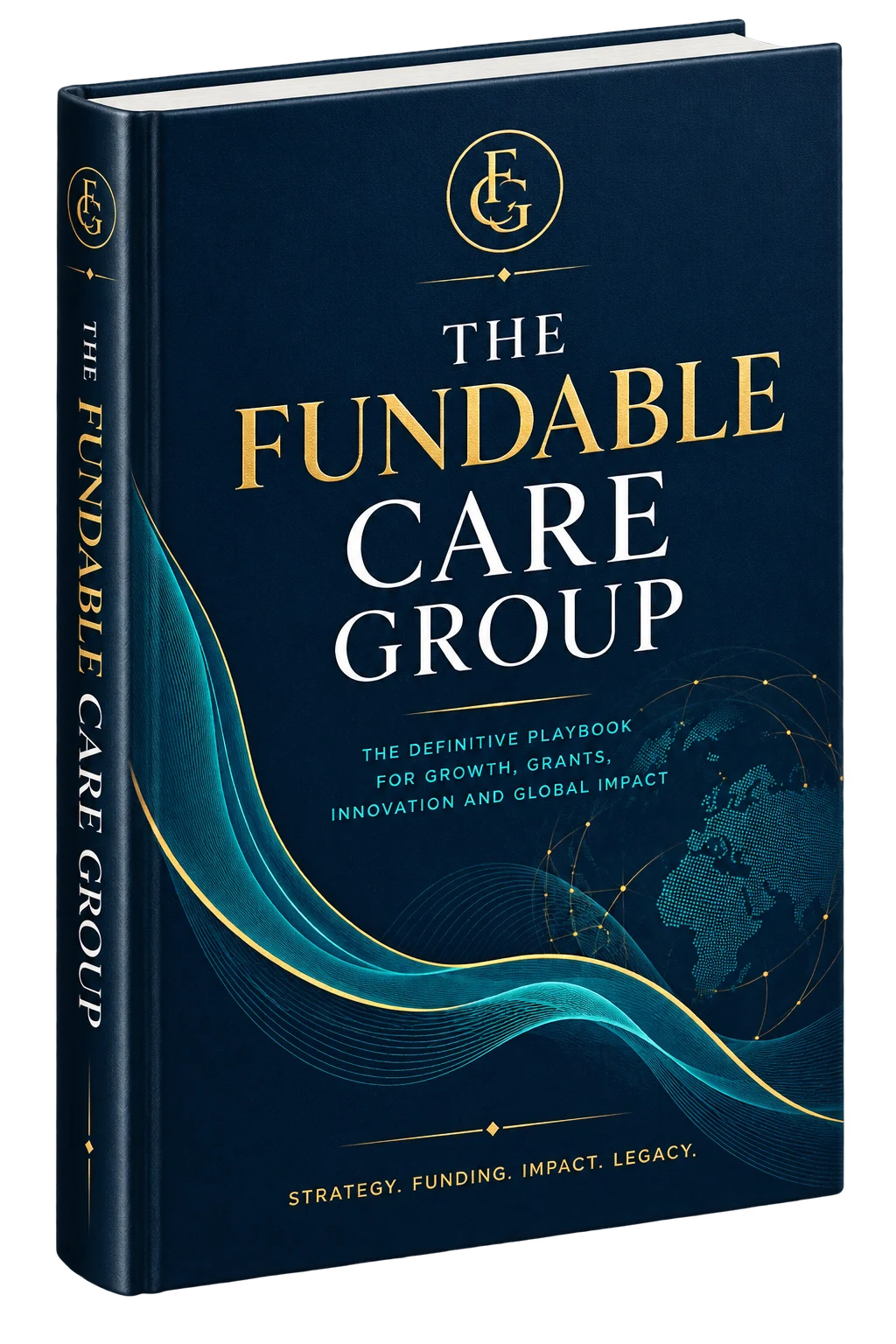
Three-dimensional cover of The Fundable Care Group by Achmed Esser

From funding search to growth architecture

Make the whole care group fundable—not merely the next application.

The book starts from a practical problem: capable care organisations often pursue grants, commissioned services, property, innovation and charitable ambitions as separate activities. That produces noisy pipelines, duplicated effort and applications that do not match the eligible entity, payer, evidence burden or delivery model.

The alternative is one governed growth-management system. It separates seven forms of capital, qualifies addressable opportunities, turns needs into executable projects, creates an evidence room and gives the board decision-grade visibility of risk, capacity, cash and delivery.

It is written for chief executives, growth managers, finance leaders, property teams, clinical and operational leaders, CIC and foundation boards, bid teams and partners working across UK care, health, housing, SEND and community services.

The operating sequence

Eight decisions make a project FUNDABLE.

Each stage resolves a different reason that a promising care, property, community or innovation project might fail to attract money—or fail after award.

Fit

Fit the legal entity, funding route and risk before committing resource.

Understand

Understand the buyer, funder, market and route to a decision.

Name

Name a validated need clearly enough for outcomes to be measured.

Design

Design the intervention and delivery model before writing the application.

Assemble

Assemble evidence, partners, permissions and accountable owners.

Build

Build a coherent business case, cost model and honest budget.

Lead

Lead the application, procurement or investment route through to award.

Execute

Execute, evidence results and expand only from proven delivery.

The Seven-Capital Stack

Stop calling every source of money a grant.

Funding behaves differently according to what the payer is buying, who may receive it, what risk it carries and how success must be evidenced. The book separates seven economic engines before showing how they can be combined without double-funding or hidden cross-subsidy.

Commissioned revenue

Contracts, placements, frameworks, spot purchasing and call-offs for defined services or outcomes.

Statutory and individual funding

Public entitlements and personal routes that follow eligibility, assessment and authorised use.

Property capital

Funding and finance for assets, adaptations, development, safety, energy and specialist accommodation.

Innovation and R&D

Awards that fund uncertainty, evidence generation, adoption and genuinely novel work.

Community and charitable funding

Restricted support for public benefit, participation, early intervention and community capacity.

Social and blended investment

Repayable or return-seeking capital supported by credible cash flow, governance and downside control.

International funding

Grants, procurement, partnerships and development finance with heightened delivery and ethical controls.

Applied care-sector growth

The funding and contract routes are specific to the work.

The sector chapters show why a single generic funding search cannot serve every part of a diversified care organisation. Each field has a different buyer, legal route, evidence threshold, commercial model and partner requirement.

  1. Disabled Facilities Grants and adaptations
  2. Specialist property and supported housing
  3. Complex care and supported living
  4. Clinical services, secure transport and specialist staffing
  5. Children’s services, SEND and alternative provision
  6. Care innovation and research funding
  7. CIC, community and foundation funding
  8. International humanitarian health, education and skills

From the book

Three ideas that change the funding conversation.

“Most care groups do not have a shortage of opportunity. They have a shortage of architecture.”The commercial thesis
“Success is not the number of applications submitted.”The real mandate
“Treat award as the start of accountability rather than the end of a bid.”The operating principle

Complete complimentary edition

Read The Fundable Care Group now.

Use the section selector or the controls inside the embedded PDF. The full-screen and download options remain available if your device does not support embedded documents.

The opportunity atlas is a research snapshot dated 2 September 2026. Always verify eligibility, deadlines, amendments and current documents at the official source before acting.

Questions answered

Using the care funding and growth blueprint.

Is The Fundable Care Group free to read and download?

Yes. This page provides the complete 144-page first edition for immediate browser reading and free PDF download. No payment, registration or email address is required.

Is this a directory of social care grants?

No. It includes a dated September 2026 atlas of 75 routes and signals, but its lasting purpose is to help a care group match each project to the correct legal entity, payer, evidence standard and award route. Live opportunities must always be rechecked at source.

Which care funding areas does the book cover?

It covers commissioned care contracts, supported living, specialist housing and property capital, Disabled Facilities Grants and adaptations, clinical services, secure transport, specialist staffing, children’s services and SEND, care innovation and R&D, CIC and community funding, social investment and international programmes.

Who should use the growth-management system?

The system is designed for care-group chief executives, growth and bid managers, finance and property leaders, operational and clinical teams, social-enterprise and foundation boards, and delivery partners responsible for turning opportunities into safe, measurable work.

What practical tools are included?

The fieldbook contains 16 working tools for the opportunity radar, project charter, entity and route fit, evidence readiness, partnership decisions, budgets, bid/no-bid control, pipeline economics, governance, mobilisation and learning.